M203 20260207 Trigonometric Identities
1. Unit circle
| Identity (Formula) | Brief Proof / Derivation |
|---|---|
| $\sin \alpha = \dfrac{y}{r}, \cos \alpha = \dfrac{x}{r}$ | Defined via the unit circle/right triangle where $r$ is the hypotenuse. |
| $\tan \alpha = \dfrac{y}{x}, \cot \alpha = \dfrac{x}{y}$ | Derived from the ratios of the opposite, adjacent sides. |
| $\sec \alpha = \dfrac{r}{x}, \csc \alpha = \dfrac{r}{y}$ | Reciprocals of $\cos \alpha$ and $\sin \alpha$ respectively. |
| $\sin^2 \alpha + \cos^2 \alpha = 1$ | From Pythagorean theorem: $x^2 + y^2 = r^2 \Rightarrow (\dfrac{x}{r})^2 + (\dfrac{y}{r})^2 = 1$. |
| $1 + \tan^2 \alpha = \sec^2 \alpha$ | Divide $\sin^2 \alpha + \cos^2 \alpha = 1$ by $\cos^2 \alpha$. |
| $1 + \cot^2 \alpha = \csc^2 \alpha$ | Divide $\sin^2 \alpha + \cos^2 \alpha = 1$ by $\sin^2 \alpha$. |
| $\tan \alpha = \dfrac{\sin \alpha}{\cos \alpha}$ | Substitute ratios: $\dfrac{y/r}{x/r} = \dfrac{y}{x}$. |
| $\sin(90^\circ - \alpha) = \cos \alpha$ | Cofunction identity: the sine of an angle is the cosine of its complement. |
| $\cos(90^\circ - \alpha) = \sin \alpha$ | Reflecting a point $(x, y)$ over the line $y = x$ swaps coordinates. |
| $\tan(90^\circ - \alpha) = \cot \alpha$ | Ratio of $\dfrac{\cos \alpha}{\sin \alpha}$ based on the cofunction identities above. |
| $\cot(90^\circ - \alpha) = \tan \alpha$ | Reciprocal of the tangent cofunction identity. |
| $\sin(90^\circ + \alpha) = \cos \alpha$ | Rotation of $90^\circ$ maps $(x, y) \to (-y, x)$; new sine is $x/r$. |
| $\cos(90^\circ + \alpha) = -\sin \alpha$ | Rotation of $90^\circ$ maps $(x, y) \to (-y, x)$; new cosine is $-y/r$. |
| $\tan(90^\circ + \alpha) = -\cot \alpha$ | Ratio: $\dfrac{\cos \alpha}{-\sin \alpha} = -\cot \alpha$. |
| $\sin(180^\circ - \alpha) = \sin \alpha$ | Reflection across the $y$-axis preserves the $y$-coordinate. |
| $\cos(180^\circ - \alpha) = -\cos \alpha$ | Reflection across the $y$-axis negates the $x$-coordinate. |
| $\tan(180^\circ - \alpha) = -\tan \alpha$ | Ratio: $\dfrac{\sin \alpha}{-\cos \alpha} = -\tan \alpha$. |
| $\sin(180^\circ + \alpha) = -\sin \alpha$ | Rotation of $180^\circ$ (Point Reflection) negates both $x$ and $y$. |
| $\cos(180^\circ + \alpha) = -\cos \alpha$ | Both coordinates change sign in the 3rd quadrant. |
| $\tan(180^\circ + \alpha) = \tan \alpha$ | Ratio: $\dfrac{-y}{-x} = \dfrac{y}{x}$. Tangent is positive in the 3rd quadrant. |
| $\sin(360^\circ - \alpha) = -\sin \alpha$ | Reflection across the $x$-axis negates the $y$-coordinate. |
| $\cos(360^\circ - \alpha) = \cos \alpha$ | Reflection across the $x$-axis preserves the $x$-coordinate. |
| $\tan(360^\circ - \alpha) = -\tan \alpha$ | Ratio: $\dfrac{-y}{x} = -\tan \alpha$. |
| $\sin(360^\circ + \alpha) = \sin \alpha$ | Periodicity: adding $360^\circ$ returns to the same position. |
| $\cos(360^\circ + \alpha) = \cos \alpha$ | Periodic property of circular functions ($2\pi$ radians). |
| $\tan(360^\circ + \alpha) = \tan \alpha$ | Periodic property; the terminal side is identical. |
All Positive
(0° - 90°)"] Q2["Quadrant II (S)
Sine Positive
(90° - 180°)"] Q3["Quadrant III (T)
Tangent Positive
(180° - 270°)"] Q4["Quadrant IV (C)
Cosine Positive
(270° - 360°)"] end
- All Students Take Calculus (所有学生都学微积分)
- Add Sugar To Coffee (咖啡里加糖)
| 象限 | 英文缩写含义 | 正值的函数 | 坐标特征 |
|---|---|---|---|
| I (右上) | All | 全部 ($\sin, \cos, \tan$) | $x>0, y>0$ |
| II (左上) | Sine | 只有 $\sin$ (及 $\csc$) | $x<0, y>0$ |
| III (左下) | Tangent | 只有 $\tan$ (及 $\cot$) | $x<0, y<0$ |
| IV (右下) | Cosine | 只有 $\cos$ (及 $\sec$) | $x>0, y<0$ |
1 ) Find each of the following:
$\cos 120^\circ$, $\sec 210^\circ$, $\csc 240^\circ$, $\sin 135^\circ$, $\cot 315^\circ$, $\tan 330^\circ$, $\cos 1080^\circ$, $\cot (-45^\circ)$, $\sin 3720^\circ$, $\sec (-480^\circ)$
| Expression | Quadrant | Reference Angle (α) | Calculation | Final Value |
|---|---|---|---|---|
| $\cos 120^\circ$ | II (S) | $180^\circ - 120^\circ = 60^\circ$ | $-\cos 60^\circ$ | $-\dfrac{1}{2}$ |
| $\sec 210^\circ$ | III (T) | $210^\circ - 180^\circ = 30^\circ$ | $-\sec 30^\circ = -\dfrac{1}{\cos 30^\circ}$ | $-\dfrac{2\sqrt{3}}{3}$ |
| $\csc 240^\circ$ | III (T) | $240^\circ - 180^\circ = 60^\circ$ | $-\csc 60^\circ = -\dfrac{1}{\sin 60^\circ}$ | $-\dfrac{2\sqrt{3}}{3}$ |
| $\sin 135^\circ$ | II (S) | $180^\circ - 135^\circ = 45^\circ$ | $+\sin 45^\circ$ | $\dfrac{\sqrt{2}}{2}$ |
| $\cot 315^\circ$ | IV (C) | $360^\circ - 315^\circ = 45^\circ$ | $-\cot 45^\circ$ | $-1$ |
| $\tan 330^\circ$ | IV (C) | $360^\circ - 330^\circ = 30^\circ$ | $-\tan 30^\circ$ | $-\dfrac{\sqrt{3}}{3}$ |
| $\cos 1080^\circ$ | Axis | $1080^\circ = 3 \times 360^\circ$ | $\cos 0^\circ$ | $1$ |
| $\cot (-45^\circ)$ | IV (C) | $45^\circ$ | $-\cot 45^\circ$ | $-1$ |
| $\sin 3720^\circ$ | I (A) | $3720^\circ \pmod{360^\circ} = 120^\circ \to 60^\circ$ | $+\sin 60^\circ$ | $\dfrac{\sqrt{3}}{2}$ |
| $\sec (-480^\circ)$ | III (T) | $-480^\circ + 720^\circ = 240^\circ \to 60^\circ$ | $-\sec 60^\circ$ | $-2$ |
2 ) Convert the degree measures to radians, and radians to degrees:
- $60^\circ$
- $-315^\circ$
- $288^\circ$
- $1400^\circ$
- $\dfrac{2\pi}{5}$
- $-\dfrac{7\pi}{3}$
- $\dfrac{4\pi}{3}$
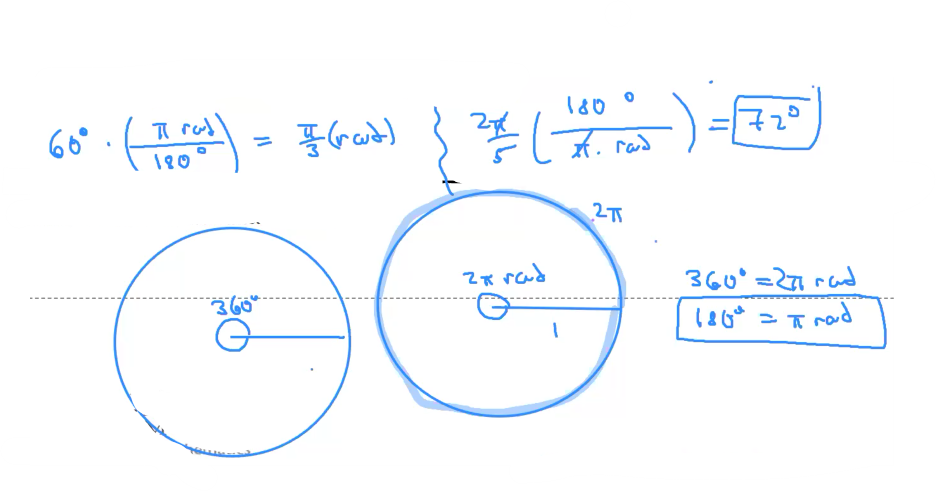
| Original Measure | Conversion Process | Result (LaTeX) |
|---|---|---|
| $60^\circ$ | $60 \times \dfrac{\pi}{180}$ | $\dfrac{\pi}{3}$ |
| $-315^\circ$ | $-315 \times \dfrac{\pi}{180} = -\dfrac{63\pi}{36}$ | $-\dfrac{7\pi}{4}$ |
| $288^\circ$ | $288 \times \dfrac{\pi}{180} = \dfrac{72\pi}{45}$ | $\dfrac{8\pi}{5}$ |
| $1400^\circ$ | $1400 \times \dfrac{\pi}{180} = \dfrac{140\pi}{18}$ | $\dfrac{70\pi}{9}$ |
| $\dfrac{2\pi}{5}$ | $\dfrac{2\pi}{5} \times \dfrac{180}{\pi} = 2 \times 36$ | $72^\circ$ |
| $-\dfrac{7\pi}{3}$ | $-\dfrac{7\pi}{3} \times \dfrac{180}{\pi} = -7 \times 60$ | $-420^\circ$ |
| $\dfrac{4\pi}{3}$ | $\dfrac{4\pi}{3} \times \dfrac{180}{\pi} = 4 \times 60$ | $240^\circ$ |
3 ) Simplify: $\dfrac{(\csc x)(\sec x)}{1 + \tan^2 x}$
1. Sine Function
$\sin x = \sin y$ iff:
* $x = y \pm n \cdot 360^\circ$
* OR $x = 180^\circ - y \pm n \cdot 360^\circ$
2. Cosine Function
$\cos x = \cos y$ iff:
* $x = y \pm n \cdot 360^\circ$
* $x = -y \pm n \cdot 360^\circ$
3. Tangent Function
$\tan x = \tan y$ iff:
* $x = y \pm n \cdot 180^\circ$
4 ) Find the smallest positive angle such that $\sin 2a = \cos 3a$.
| Function | Formula |
|---|---|
| $\sin(a \pm b)$ | $\sin a \cos b \pm \cos a \sin b$ |
| $\cos(a \pm b)$ | $\cos a \cos b \mp \sin a \sin b$ |
| $\tan(a \pm b)$ | $\dfrac{\tan a \pm \tan b}{1 \mp \tan a \tan b}$ |
* Sine is "Social": Sine mixes the functions ($\sin \cos$) and keeps the sign (plus stays plus, minus stays minus).
* Cosine is "Contrary": Cosine keeps the functions pure ($\cos \cos$ and $\sin \sin$) but flips the sign (plus becomes minus, minus becomes plus).
Tangent is "Fractional": > The numerator keeps the original sign.
* The denominator uses the opposite sign and includes the product of the tangents.
Example:
Find:
1. $\sin(30^\circ + 45^\circ)$
2. $\cos(30^\circ + 45^\circ)$
3. $\tan(30^\circ + 45^\circ)$
| 角度 | sin | cos | tan |
|---|---|---|---|
| 30° | $\dfrac{1}{2}$ | $\dfrac{\sqrt{3}}{2}$ | $\dfrac{\sqrt{3}}{3}$ |
| 45° | $\dfrac{\sqrt{2}}{2}$ | $\dfrac{\sqrt{2}}{2}$ | 1 |
| 75° | $\dfrac{\sqrt{2}+\sqrt{6}}{4}$ | $\dfrac{\sqrt{6}-\sqrt{2}}{4}$ | $2+\sqrt{3}$ |
| 15° | $\dfrac{\sqrt{6}-\sqrt{2}}{4}$ | $\dfrac{\sqrt{2}+\sqrt{6}}{4}$ | $\dfrac{1}{2+\sqrt{3}} = 2-\sqrt{3}$ |
3. Double and Half Angles
$\sin 2x = 2(\sin x)(\cos x)$
$\cos 2x = \cos^2 x - \sin^2 x = 2\cos^2 x - 1 = 1 - 2\sin^2 x$
$\tan 2x = \dfrac{2\tan x}{1 - \tan^2 x}$
$\sin\left(\dfrac{x}{2}\right) = \pm\sqrt{\dfrac{1 - \cos x}{2}}$
$\cos\left(\dfrac{x}{2}\right) =\pm \sqrt{\dfrac{1 + \cos x}{2}}$
$\tan\left(\dfrac{x}{2}\right) = \pm \dfrac{\sin x}{1 + \cos x} = \pm\dfrac{1 - \cos x}{\sin x}$
1 ) Compute the number of degrees in the smallest positive angle $x$ that satisfies the equation $8\sin x \cos^5 x - 8 \sin^5 x \cos x = 1$.
2 ) Find $(\cos 20^\circ)(\cos 40^\circ)(\cos 80^\circ)$
4. Sum to product and product to sum
| Product | Equivalent Sum/Difference |
|---|---|
| $\sin \alpha \cos \beta$ | $\frac{1}{2} [\sin(\alpha + \beta) + \sin(\alpha - \beta)]$ |
| $\cos \alpha \sin \beta$ | $\frac{1}{2} [\sin(\alpha + \beta) - \sin(\alpha - \beta)]$ |
| $\cos \alpha \cos \beta$ | $\frac{1}{2} [\cos(\alpha + \beta) + \cos(\alpha - \beta)]$ |
| $\sin \alpha \sin \beta$ | $\frac{1}{2} [\cos(\alpha - \beta) - \cos(\alpha + \beta)]$ |
* The "Sine" Rule (Mixed): If the functions are different ($\sin$ and $\cos$), the result uses Sine terms.
* If $\sin$ is the "leader" (first), it's a Sum ($+$).
* If $\cos$ is the "leader", it's a Difference ($-$).
* The "Cosine" Rule (Same): If the functions are the same, the result uses Cosine terms.
* $\cos \cdot \cos$ is a Sum ($+$).
* $\sin \cdot \sin$ is a Difference ($-$), and the angles are swapped ($\alpha - \beta$ comes first).
* The Coefficient: Every formula is multiplied by $\frac{1}{2}$ because they are derived by halving the sum/difference identities.
| Sum or Difference | Equivalent Product |
|---|---|
| $\sin A + \sin B$ | $2 \sin\left(\frac{A+B}{2}\right) \cos\left(\frac{A-B}{2}\right)$ |
| $\sin A - \sin B$ | $2 \cos\left(\frac{A+B}{2}\right) \sin\left(\frac{A-B}{2}\right)$ |
| $\cos A + \cos B$ | $2 \cos\left(\frac{A+B}{2}\right) \cos\left(\frac{A-B}{2}\right)$ |
| $\cos A - \cos B$ | $-2 \sin\left(\frac{A+B}{2}\right) \sin\left(\frac{A-B}{2}\right)$ |
* Sine Sums are "Mixed": Adding or subtracting Sines always results in a mix of one Sine and one Cosine.
* Cosine Sums are "Pure":
* $\cos + \cos$ results in all Cosines.
* $\cos - \cos$ results in all Sines (remember the negative sign at the front!).
* The Angles: In all four formulas, the first angle in the product is the average $\frac{A+B}{2}$ and the second is the half-difference $\frac{A-B}{2}$.
$1)$ Compute $\dfrac{\sin 13^\circ + \sin 47^\circ + \sin 73^\circ + \sin 107^\circ}{\cos 17^\circ}$
2 ) Simplify $\dfrac{\cos 4x - \cos 2x}{2\sin 3x}$ for all $x$.
📝 Homework & Extensions
Suppose that $\sec x + \tan x = a$, find $\csc x + \cot x$
Weierstrass Substitution Core
By setting $t = \tan(x/2)$, all trigonometric functions can be expressed as rational functions of $t$:
$$\sin x = \frac{2t}{1+t^2}, \quad \cos x = \frac{1-t^2}{1+t^2}, \quad \tan x = \frac{2t}{1-t^2}$$
---
Application to the Question
1. Given: $\sec x + \tan x = a$
Using the substitution:
$$\frac{1+t^2}{1-t^2} + \frac{2t}{1-t^2} = \frac{t^2+2t+1}{1-t^2} = \frac{(1+t)^2}{(1+t)(1-t)} = \frac{1+t}{1-t}$$
Using the tangent addition formula $\tan(x/2 + \pi/4) = \dfrac{\tan(x/2) + \tan(\pi/4)}{1 - \tan(x/2)\tan(\pi/4)} = \dfrac{t+1}{1-t}$, we find:
$$a = \frac{1+t}{1-t}$$
2. Target: $\csc x + \cot x$
Using the substitution:
$$\frac{1+t^2}{2t} + \frac{1-t^2}{2t} = \frac{2}{2t} = \frac{1}{t}$$
Alternatively, via the half-angle identity: $\cot(x/2) = \frac{1+\cos x}{\sin x} = \csc x + \cot x$.
3. Final Solution
Solve for $t$ in terms of $a$ from Step 1:
$$a(1-t) = 1+t \implies a - at = 1+t \implies a-1 = t(a+1) \implies t = \frac{a-1}{a+1}$$
Since the target is $\frac{1}{t}$:
$$\csc x + \cot x = \frac{1}{t} = \mathbf{\frac{a+1}{a-1}}$$
The Auxiliary Angle Formula is a powerful tool used to combine a linear combination of sine and cosine into a single trigonometric function. This is essential for solving equations, finding maximum/minimum values, and simplifying complex expressions in competitions like the AMC.
The general formula is:
$$a \sin x + b \cos x = \sqrt{a^2 + b^2} \sin(x + \phi)$$
Where the phase shift $\phi$ is determined by:
$$\cos \phi = \frac{a}{\sqrt{a^2 + b^2}} \quad \text{and} \quad \sin \phi = \frac{b}{\sqrt{a^2 + b^2}} \implies \tan \phi = \frac{b}{a}$$
---
Example 1: Finding the Maximum Value
Problem: Find the maximum value of $f(x) = 3 \sin x + 4 \cos x$.
Solution:
1. Identify $a=3$ and $b=4$.
2. Calculate the amplitude: $\sqrt{3^2 + 4^2} = \sqrt{25} = 5$.
3. The expression becomes: $5 \sin(x + \phi)$, where $\tan \phi = \frac{4}{3}$.
4. Since the range of a sine function is $[-1, 1]$, the range of $5 \sin(x + \phi)$ is $[-5, 5]$.
Result: The maximum value is 5.
---
Example 2: Solving an Equation with Special Angles
Problem: Solve $\sin x - \sqrt{3} \cos x = 1$ for $0 \le x < 2\pi$.
Solution:
1. $a=1, b=-\sqrt{3}$. Amplitude: $\sqrt{1^2 + (-\sqrt{3})^2} = 2$.
2. Factor out the 2: $2 \left( \frac{1}{2} \sin x - \frac{\sqrt{3}}{2} \cos x \right) = 1$.
3. Recognize $\cos(60^\circ) = \frac{1}{2}$ and $\sin(60^\circ) = \frac{\sqrt{3}}{2}$.
4. Apply the sine difference formula: $2 \sin(x - 60^\circ) = 1$.
5. $\sin(x - 60^\circ) = \frac{1}{2}$.
- $x - 60^\circ = 30^\circ \implies x = 90^\circ$ ($\frac{\pi}{2}$)
- $x - 60^\circ = 150^\circ \implies x = 210^\circ$ ($\frac{7\pi}{6}$)
Result: $x = 90^\circ, 210^\circ$.
---
Example 3: The $\sqrt{2}$ Shortcut (Very Common in AMC)
Problem: Simplify $\sin x + \cos x$.
Solution:
When $a=1$ and $b=1$, the amplitude is $\sqrt{2}$ and the angle $\phi$ is $45^\circ$ (or $\frac{\pi}{4}$).
$$\sin x + \cos x = \sqrt{2} \sin(x + 45^\circ)$$
The "Mental Math" Trick
If you see coefficients $(1, 1)$, think $\sqrt{2} \sin(x + 45^\circ)$.
If you see coefficients $(1, \sqrt{3})$ or $(\sqrt{3}, 1)$, think $2 \sin(x \pm 30^\circ \text{ or } 60^\circ)$.
This shortcut saves precious seconds during timed math competitions!
---
Summary Table for Quick Reference
| Expression | Combined Form | Phase Shift (ϕ) |
|---|---|---|
| $\sin x + \cos x$ | $\sqrt{2} \sin(x + 45^\circ)$ | $45^\circ$ |
| $\sin x - \cos x$ | $\sqrt{2} \sin(x - 45^\circ)$ | $-45^\circ$ |
| $\sqrt{3} \sin x + \cos x$ | $2 \sin(x + 30^\circ)$ | $30^\circ$ |
| $\sin x + \sqrt{3} \cos x$ | $2 \sin(x + 60^\circ)$ | $60^\circ$ |
To master the Triple Angle Formulas for competitions like the AMC 10/12, you need both the standard forms and the "hidden" product forms that frequently appear in simplification problems.
1. The Standard Formulas
These are the foundational identities. A common mnemonic to remember the coefficients is "43" for Cosine and "34" for Sine.
- Sine Triple Angle:
$$\sin 3x = 3\sin x - 4\sin^3 x$$
- Cosine Triple Angle:
$$\cos 3x = 4\cos^3 x - 3\cos x$$
- Tangent Triple Angle:
$$\tan 3x = \frac{3\tan x - \tan^3 x}{1 - 3\tan^2 x}$$
---
2. The "Hidden" Product Trick (High-Level)
This is the most powerful version for competition math. It allows you to convert the triple angle into a product of three terms, which is perfect for canceling terms in fractions.
$$\sin 3x = 4\sin x \sin(60^\circ - x) \sin(60^\circ + x)$$
$$\cos 3x = 4\cos x \cos(60^\circ - x) \cos(60^\circ + x)$$
$$\tan 3x = \tan x \tan(60^\circ - x) \tan(60^\circ + x)$$
The $20^\circ-40^\circ-80^\circ$ Pattern
If you see a product like $\sin 20^\circ \sin 40^\circ \sin 80^\circ$, it is almost always a $3x$ trick.
Here $x = 20^\circ$, so:
$$\sin 20^\circ \sin(60^\circ-20^\circ) \sin(60^\circ+20^\circ) = \frac{1}{4} \sin(3 \cdot 20^\circ) = \frac{1}{4} \sin 60^\circ = \frac{\sqrt{3}}{8}$$
---
3. The Ratio Trick
As we used in a previous problem, the ratio of a triple angle to its single angle is often just a shifted version of $\cos 2x$. This is a huge time-saver!
- Sine Ratio:
$$\frac{\sin 3x}{\sin x} = 3 - 4\sin^2 x = 2\cos 2x + 1$$
- Cosine Ratio:
$$\frac{\cos 3x}{\cos x} = 4\cos^2 x - 3 = 2\cos 2x - 1$$
Mnemonic for Ratios
- Sine is Super (Plus): $2\cos 2x \mathbf{+ 1}$
- Cosine is Cold (Minus): $2\cos 2x \mathbf{- 1}$
---
4. Practice Application
Problem: Simplify $4\cos^3 20^\circ - 3\cos 20^\circ$.
Solution:
Recognize the pattern $4\cos^3 \theta - 3\cos \theta$. This is exactly the formula for $\cos 3\theta$.
- Set $\theta = 20^\circ$.
- Result $= \cos(3 \cdot 20^\circ) = \cos 60^\circ = \frac{1}{2}$.
---
Summary Table
| Goal | Formula / Trick |
|---|---|
| Expansion | $\sin 3x = 3\sin x - 4\sin^3 x$ / $\cos 3x = 4\cos^3 x - 3\cos x$ |
| Product | $\sin 3x = 4\sin x \sin(60-x)\sin(60+x)$ |
| Fraction | $\dfrac{\sin 3x}{\sin x} = 2\cos 2x + 1$ |
| Tangent | $\tan x \tan(60-x) \tan(60+x) = \tan 3x$ |